The Abacus: A Brief History
Abacus is a Latin word that has its origins in the Greek words abax or abakon (meaning "table" or "tablet") which in turn, possibly originated from the Semitic word abq, meaning "sand". The abacus is one of many types of counting devices which are used to count large numbers.
Why does the abacus exist?
It is difficult to imagine counting without numbers, but there was a time when written numbers did not exist. The earliest counting device was the human hand and its fingers, capable of counting up to 10 things; toes were also used to count in tropical cultures. Then, as even larger quantities (greater than ten fingers and toes could represent) were counted, various natural items like pebbles, sea shells and twigs were used to help keep count.
Merchants who traded goods needed a way to keep count (inventory) of the goods they bought and sold. Various portable counting devices were invented to keep tallies. The abacus is one of many counting devices invented to help count large numbers. When the Hindu-Arabic number system came into use, abaci were adapted to use place-value counting.
Abaci evolved into electro-mechanical calculators, pocket slide-rules, electronic calculators and now abstract representations of calculators or simulations on smartphones.
What is the difference between a counting board and an abacus?
It is important to distinguish the early abacuses (or abaci) known as counting boards from the modern abaci. The counting board is a piece of wood, stone or metal with carved grooves or painted lines between which beads, pebbles or metal discs were moved. The abacus is a device, usually of wood (romans made them out of metal and they are made of plastic in modern times), having a frame that holds rods with freely-sliding beads mounted on them.
Both the abacus and the counting board are mechanical aids used for counting; they are not calculators in the sense we use the word today. The person operating the abacus performs calculations in their head and uses the abacus as a physical aid to keep track of the sums, the carrys, etc.
What did the first counting board look like?
The earliest counting boards are forever lost because they were constructed of perishable materials like wood.
Educated guesses can be made about the construction of counting boards based on early writings of Plutarch and others.
Used in outdoor markets of those times, the simplest counting board involved drawing lines in the sand with ones fingers or with a stylus, and placing pebbles between those lines as place-holders representing numbers (the spaces between the lines would represent the units 10s, 100s, etc.); two pebbles inthe 10s column would indicate 20. Affluent merchants could afford small wooden tables having raised borders that were filled with sand (usually coloured blue or green). A benefit of these counting boards on tables, was that they could be moved without disturbing the calculation— the table could be picked up and carried indoors.
With the need for portable devices, wooden boards with grooves carved into the surface were then created and wooden markers (small discs) were used as place-holders. The wooden boards then gave way to even more more durable materials like marble and metal (bronze) used with stone or metal markers.
COUNTING DEVICES THROUGH THE AGES
The evolution of the counting device can be divided into three ages: Ancient Times, Middle Ages, and Modern Times.
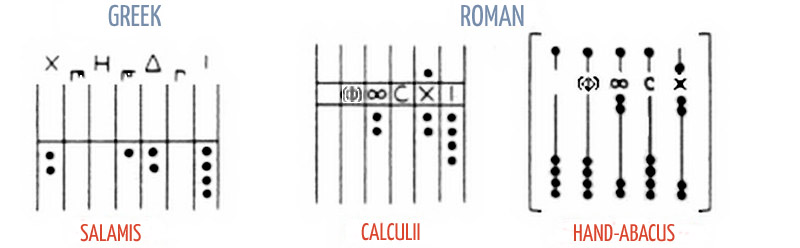
THE SALAMIS TABLET
The oldest surviving counting board is the Salamis tablet (originally thought to be a gaming board), used by the Babylonians circa 300 B.C., discovered in 1846 on the island of Salamis.
It is a slab of white marble measuring 149cm in length, 75cm in width and 4.5cm thick, on which are 5 groups of markings. In the center of the tablet are a set of 5 horizontal parallel lines divided equally by a perpendicular vertical line, capped with a semi-circle at the intersection of the bottom-most horizontal line and the vertical line.
Below these lines is a wide space with a horizontal crack dividing it. Below this crack is another group of eleven parallel lines, again divided into two sections by a line perpendicular to them but with the semi-circle at the top of the intersection; the third, sixth and ninth of these lines are marked with a cross where they intersect with the vertical line.
Three sets of Greek symbols (numbers from the acrophonic system) are arranged along the left, right and bottom edges of the tablet.
During Greek and Roman times, counting boards, like the Roman hand-abacus, that survive are constructed from stone and metal (as a point of reference, the Roman empire fell circa 500 C.E.).
THE MIDDLE AGES
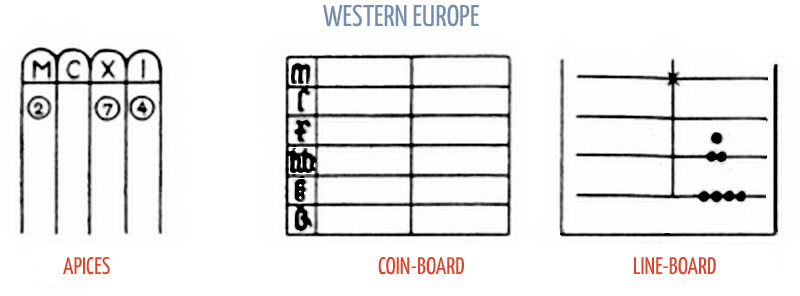
The Apices, the Coin-board and the Line-board are from the period c. 5 C.E. to c. 1400 C.E
THE EXCHEQUER
The “exchequer” derives is name from the chequered table which was used in England from c. 1100 for calculating expenditure and receipts.
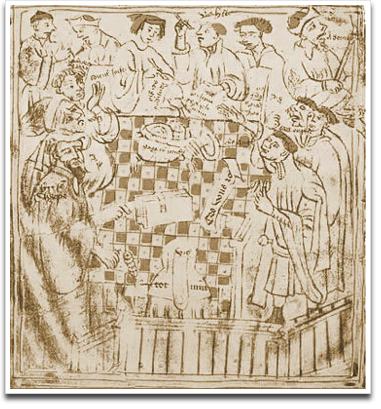
“The Exchequer is an oblong board measuring about 10 feet by 5...with a rim around it about four finger breadths in height, to prevent anything set on it from falling off. Over it is spread a cloth, bought in Easter term, with a special pattern, black, ruled with lines a foot, or a full span, apart. In the spaces between them are placed the counters, in their ranks.
The accountant sits in the middle of his side of the table, so that everybody can see him, and so that his hand can move freely at its work. In the lowest space on the right, he places the heap of the pence; in the second the shillings; in the third the pounds…As he reckons, he must put out the counters and state the numbers simultaneously, lest there should be a mistake in the number. When the sum demanded of the sheriff has been set out in heaps of counters, the payments made into the Treasury or otherwise are similarly set out in heaps underneath. The lower line is simply subtracted from the upper.”
—The Dialogue on the Exchequer, 1177.
—The Dialogue on the Exchequer, 1177.
In the Middle Ages, wood became the primary material for manufacturing counting boards; the orientation of the beads also switched from vertical to horizontal. In Western Europe, as arithmetic (calculating using written numbers) gained in popularity in the latter part of the Middle Ages, the use of counting boards began to diminish and eventually disappear by 1500.
Arithmetic brought about the invention of logarithms by John Napier and logarithmic scales by Edmund Gunter. In 1622, William Oughtred used these two inventions together and invented the slide rule which lasted until modern times when the scientific calculator became popular in the early 1970s.


